Summary — In 2023, building an AI application was a practice in “prompt engineering.” You wrote a poem to a Large Language Model (LLM), crossed your fingers, and hoped the output didn’t hallucinate. It was alchemy—impressive, but…
In 2023, building an AI application was a practice in “prompt engineering.” You wrote a poem to a Large Language Model (LLM), crossed your fingers, and hoped the output didn’t hallucinate. It was alchemy—impressive, but unrepeatable.
By 2026, the alchemy has hardened into chemistry. The era of the “AI Wrapper”—a thin UI pasted over an OpenAI API call—is dead. It has been replaced by the Agentic Stack: a robust, standardized, and increasingly complex set of infrastructure designed not just to generate text, but to execute work.
For CIOs and engineering leaders, the question is no longer “Which model should we use?” (a commodity decision) but “What does our runtime look like?” The architecture of autonomy has arrived, and it looks nothing like the software stacks of the last decade.
Here is the anatomy of the new runtime.
1. The Connector Layer: The Model Context Protocol (MCP)
For years, the biggest bottleneck in AI development was the “N×M” problem. If you wanted your AI to talk to Google Drive, Salesforce, and Slack, you had to write custom API wrappers for each one. If you switched models—say, from GPT-4 to Claude 3.5—you often had to rewrite that glue code.
Enter the Model Context Protocol (MCP).
Introduced by Anthropic and rapidly adopted as an open standard, MCP is effectively the “USB-C” of the AI world. It decouples the model from the tools. Instead of hard-coding a “Salesforce Integration” into your bot, you simply point your agent at an MCP Server running on your Salesforce instance.
The MCP standardizes three things:
- Context: How the model reads data (e.g., “Read the last 5 emails from Alice”).
- Tools: How the model executes actions (e.g., “Schedule a meeting”).
- Prompts: How the server guides the model’s behavior.
This has profound implications. It means your data sources are no longer “plug-ins” but portable servers. You can swap the brain (the LLM) without changing the hands (the tools). In 2026, a “Data Warehouse” isn’t just for storage; it’s an active participant that exposes its own MCP server, ready to be queried by any authorized agent in the company.
2. The Orchestration Layer: From Chains to Graphs
In the early days (2024), we built “Chains.” A chain is a linear sequence: Step A -> Step B -> Step C. This works for simple tasks, but it fails catastrophically in the real world. Real work is messy. It involves loops, retries, and conditional logic.
This reality birthed the Graph-Based Orchestration engines, with LangGraph (emerging from the LangChain ecosystem) and CrewAI leading the market.
The Shift to “Cyclic” Control Flow
Unlike a chain, a graph allows for cycles. Consider a “Code Writer” agent. In a linear chain, it writes code and stops. In a graph architecture:
- Node A (Writer): Drafts the code.
- Node B (Compiler): Tries to run it.
- Edge (Condition): If the code fails, the flow loops back to Node A with the error message.
- Node A (Writer): Fixes the code based on the error.
This loop continues until the condition (Success) is met. This is the technical definition of “Agency”—the ability to perceive errors and self-correct without human intervention.
Multi-Agent Topologies
We are also seeing distinct “organizational charts” for software:
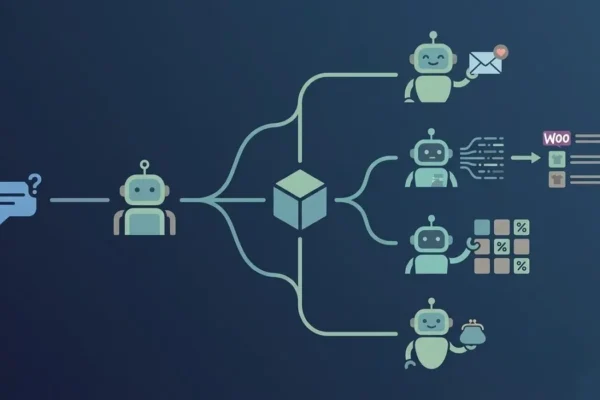
- The Supervisor Pattern: A central “Router” agent breaks down a user request (“Build a website”) and assigns tasks to worker agents (Coder, Designer, copywriter).
- The Hierarchical Team: A “Manager” agent oversees a “Worker” agent, stepping in only when the worker’s confidence score drops below a threshold.
3. The Data Layer: “Agentic RAG” and Long-Term Memory
Retrieval-Augmented Generation (RAG)—the practice of letting AI read your documents—has undergone a massive upgrade.
Standard RAG was a glorified keyword search. You asked a question, it found similar paragraphs in a database, and summarized them. It failed if the answer required synthesizing data from three different documents.
Agentic RAG introduces a “Planner” before the search. When you ask, “How did our Q3 marketing spend compare to Q2 revenue growth?” an Agentic RAG system doesn’t just search. It plans:
- Fetch Q3 marketing spend from the Finance MCP server.
- Fetch Q2 revenue growth from the Analytics database.
- Use the Python Code Interpreter tool to calculate the correlation.
- Synthesize the answer.
The Memory Problem
Agents also need to remember you. Vector databases (like Pinecone or Weaviate) handle semantic knowledge, but Episodic Memory is the new frontier. Tools like Mem0 or Zep provide a “knowledge graph” of the user’s history. If you tell your agent, “I hate Python, use Rust,” it doesn’t just store that text. It updates a stateful profile: User_Preference: {Language: Rust, Avoid: Python}. Six months later, it will still refuse to write Python, because that memory is pinned to its state.
4. The Governance Layer: “Agentic FinOps”
The most terrifying moment for an AI engineer in 2026 is not a sentient robot; it is the API Bill.
Autonomous loops are expensive. An agent stuck in a “retry loop”—trying to fix a bug, failing, and trying again 5,000 times in a minute—can burn through a monthly budget in an hour.
This has created a new discipline: Agentic FinOps. Observability platforms like Helicone, LangSmith, and Arize now track “Cost Per Goal” rather than just “Cost Per Token.”
We are seeing the implementation of Circuit Breakers at the infrastructure level:
- The “Veto” Layer: A separate, cheaper model (like GPT-4o mini) that reviews every high-stakes action before it executes.
- Step Limits: Hard-coded limits on how many “hops” an agent can take in a graph before it is forced to stop and ask for human help.
- Non-Human Identity (NHI) Management: Security platforms now issue credentials to agents, not people. These credentials have “time-to-live” limits. Your “Data Analyst Agent” might only have access to the production database between 9:00 AM and 5:00 PM, just like a contractor.
The Verdict: The Stack is the Strategy
The technology stack described above is not just IT plumbing; it is the new operating system of the modern enterprise.
The companies that win in the latter half of this decade will not be the ones with the best prompts. They will be the ones with the most robust Runtime. They will be the organizations that have successfully decoupled their data (MCP), architected resilient graphs (LangGraph), and built the governance rails to let these systems run safely at night.
We are done playing with chatbots. It is time to build the machine.
Key Takeaways
- MCP is the Standard: The Model Context Protocol has solved the integration nightmare, allowing agents to connect to any tool or data source without custom glue code.
- Graphs Over Chains: LangGraph and stateful architectures have replaced linear chains, enabling agents to loop, retry, and self-correct errors.
- Agentic RAG: Information retrieval is now an active planning process, not just a passive search, enabling complex multi-step data analysis.
- Memory Persistence: New memory layers (Mem0, Zep) allow agents to maintain long-term state and user preferences across sessions.
- FinOps is Critical: “Runaway loops” are a major financial risk, necessitating Circuit Breakers and strict “Cost Per Goal” monitoring.