

Summary — In July 2022, a tremor went through the SEO industry that had nothing to do with a core algorithm update. It came from a rare moment of candor by Prabhakar Raghavan, a Senior Vice President…
In July 2022, a tremor went through the SEO industry that had nothing to do with a core algorithm update. It came from a rare moment of candor by Prabhakar Raghavan, a Senior Vice President at Google. Speaking at a technology conference, he dropped a statistic that effectively signaled the end of the “Ten Blue Links” era.
“In our studies, something like almost 40% of young people, when they’re looking for a place for lunch, they don’t go to Google Maps or Search,” Raghavan admitted. “They go to TikTok or Instagram.”
For two decades, Google held a monopoly on human curiosity. If you wanted to know something, you “Googled” it. But for a generation raised on high-velocity vertical video, the static, text-heavy list of blue links feels archaic. It feels like homework.
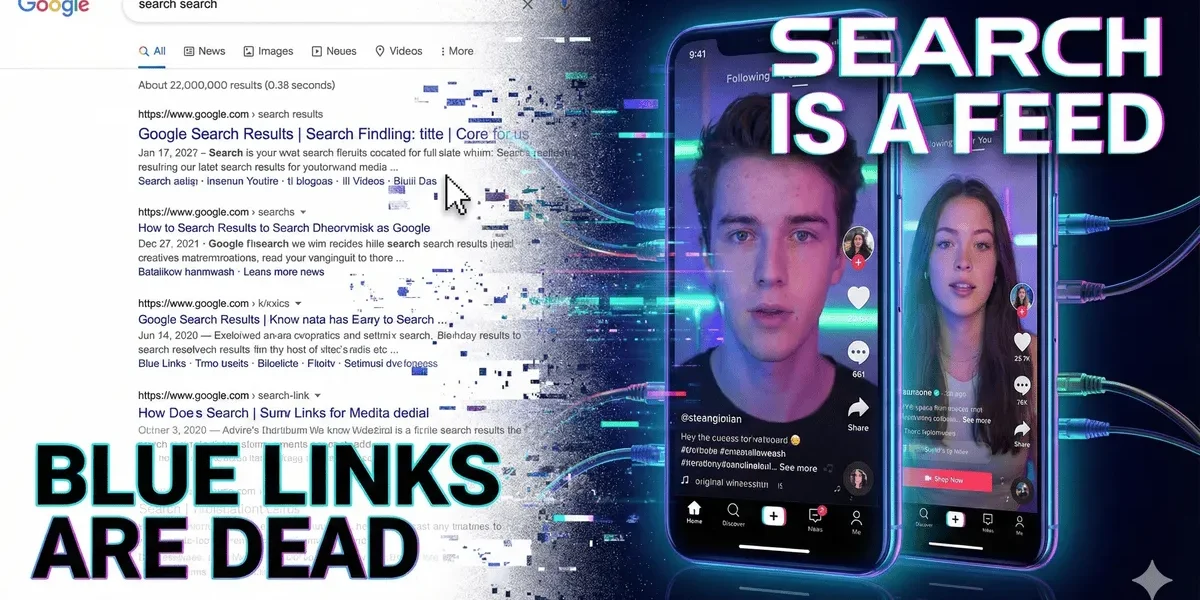
We are witnessing the “TikTok-ification” of Search. The primary interface for information discovery is shifting from the keyword to the feed, and from the article to the short-form video. For digital leaders and publishers, this is not just a platform shift; it is a fundamental breakage in the physics of how content is discovered.
The Genesis: The “Vibes” Deficiency
Why is the world’s most sophisticated indexing machine losing ground to a dancing app? The answer lies in the difference between Information and Vibes.
Traditional Google Search excels at Information. If you want to know the population of Peru or the syntax for a Python loop, Google is undefeated. But when the query is subjective—”best atmosphere for dinner in SoHo” or “how to dress for a fall wedding”—text fails.
Gen Z doesn’t want to read a 2,000-word blog post about a restaurant; they want to see the lighting, hear the ambient noise, and feel the vibe. They are trading the “Authority” of a website for the “Authenticity” of a human face.
The Trust Gap: The modern user intuitively distrusts the polished, SEO-perfected article. They know it was likely written to rank, not to help. A shaky, handheld video of a real person trying the food feels “verifiably real” in a way a 5-star Yelp review no longer does.
The Mechanics: Google’s Panic Response
Google is not ignoring this existential threat. It is aggressively re-engineering the SERP (Search Engine Results Page) to mimic the competitor that is eating its lunch.
We are seeing the rapid deployment of Visual First features:
- The “Short Videos” Carousel: Google now indexes TikToks, YouTube Shorts, and Instagram Reels, placing them directly in the SERP for queries like “recipes” or “reviews.”
- Perspectives (now “Forums and Others”): A filter designed to surface human voices from Reddit, Quora, and social video, explicitly bypassing big publishers in favor of User-Generated Content (UGC).
- Infinite Scroll: The pagination of “Page 1, Page 2” is gone, replaced by a continuous feed that encourages doom-scrolling rather than purposeful hunting.
Google is effectively trying to become a “Feed” of its own. It is admitting that in 2025, the best answer is often not a web page—it’s a 30-second clip.
The Pivot: Visual Search Optimization (VSO)
For the last 15 years, we have practiced Text SEO. We optimized H1 headers, meta descriptions, and keyword density. In 2025, we must pivot to Visual Search Optimization (VSO).
VSO is the art of making video content “readable” by search algorithms. TikTok and YouTube are not just video platforms; they are massive search engines that use Automatic Speech Recognition (ASR) and Computer Vision to index content.
Here is the new playbook for VSO:
1. Spoken Keywords (Audio SEO)
Algorithms “listen” to your video. If your target keyword is “best CRM for startups,” you must literally speak that phrase within the first 3-5 seconds of the video. The transcript is the new page copy.
- Tactic: Script your hooks to include the primary query immediately. Do not bury the lede.
2. Text Overlays as H-Tags
The text you place on top of your video (the native TikTok/Reels text) acts as metadata.
- Tactic: If you are doing a “Day in the Life,” the on-screen text should essentially function as your H2 subheaders (e.g., “Morning Routine,” “Work Setup,” “Evening Wind-down”). This gives the algorithm structure to parse.
3. The Thumbnail is the Meta Description
In a visual SERP, the Click-Through Rate (CTR) is driven entirely by the thumbnail.
- Tactic: The thumbnail must promise a specific payoff. Vague, “aesthetic” thumbnails fail in search. Use high-contrast text and clear imagery that directly addresses the search intent.
4. TikTok SEO
TikTok has introduced “Search Ads” and keyword targeting. Users are searching for “how-to” content directly in the app.
- Tactic: Use the native search bar in TikTok to find auto-complete suggestions (just like Google Suggest). Include these exact phrases in your caption and hashtags.
The Debate: The “Rental” Trap
The shift to video forces a difficult strategic conversation: Rent vs. Own.
In the “Text SEO” era, you owned the asset. You built a website, you captured an email, you owned the customer relationship. In the “TikTok-ification” era, you are building on rented land. You cannot export your TikTok followers. You cannot control the algorithm that feeds them your content. If TikTok is banned or the algorithm shifts, your traffic evaporates overnight.
The Hybrid Model: The smartest brands are using Short Video for Discovery but aggressively funneling users to owned assets (Newsletters, Communities, Apps) for Retention. You must use the “Rental” (TikTok/Shorts) to drive the “Mortgage” (Your Website).
The Future: Multimodal Agents
The endgame of this trend is Multimodal AI. Models like Google’s Gemini and OpenAI’s GPT-4o can now “watch” video. Soon, a user will ask an AI agent, “Find me the best way to chop an onion,” and the AI will watch 50 YouTube Shorts, synthesize the technique, and present the answer.
In this future, if your video is not structured clearly—if the AI cannot “see” the steps—you will not just be unranked; you will be invisible to the synthesis engine.
Conclusion
The “TikTok-ification” of search is not a fad; it is a demographic inevitability. The user interface of the internet is evolving from a library (static text) to a television (dynamic feed).
For publishers, the days of hiding behind a faceless logo and a 2,000-word wall of text are numbered. You must learn to show, not just tell. You must become comfortable with the camera, the transcript, and the feed.
The search bar is no longer just waiting for keywords. It is waiting for a show.
Key Takeaways
- The 40% Shift: Nearly half of Gen Z prefers social apps over Google for discovery.
- Vibes over Facts: Users seek visual proof of “atmosphere” and “authenticity” that text cannot provide.
- VSO is Critical: Optimize video transcripts, on-screen text, and spoken audio for search indexing.
- Google is Adapting: Expect more “Short Video” carousels and “Perspectives” in the main Google SERP.
- Don’t Build on Sand: Use viral video traffic to funnel users into owned assets (email/site) to mitigate platform risk.
